Get a Tree Inspection Today!

(973) 903 - 1641

Emerald Ash Borer ID and Treatment

Emerald Ash Borer Prevention and Treatment

How Arbor Ace Tree Service Treats Emerald Ash Borer

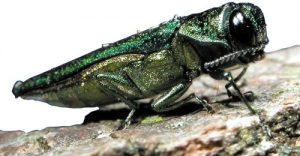
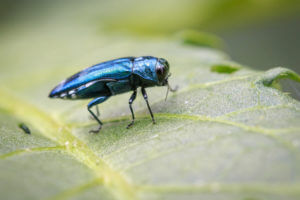
What is Emerald Ash Borer
It is a dark green bug shaped like a bullet that decimates every Ash tree it comes across. EAB feeds on the leaves of Ash trees which causes some defoliation. This is not what kills the tree, but adds to the overall decline of the tree. The real devastation occurs where it cannot be seen under the bark. The larvae, which are under the bark, destroy the cambium layer, which in turn stops water and nutrient flow, thereby killing the tree. Some signs of EAB are canopy dieback (loss of leaves), small D shaped holes in the bark of the tree, as well as epicormic growth(suckers, water sprouts) along the trunk of the tree.
Close-up of a metallic green beetle with shiny wings and black legs standing on a piece of wood, much like those found after tree removal in Montclair NJ, against a white background.A close-up of a shiny blue-green metallic beetle standing on a green leaf, with the background softly blurred, reminiscent of vibrant gardens maintained by expert tree service in Montclair NJ.
What to do when Trees are infected?
It is a dark green bug shaped like a bullet that decimates every Ash tree it comes across. EAB feeds on the leaves of Ash trees which causes some defoliation. This is not what kills the tree, but adds to the overall decline of the tree. The real devastation occurs where it cannot be seen under the bark. The larvae, which are under the bark, destroy the cambium layer, which in turn stops water and nutrient flow, thereby killing the tree. Some signs of EAB are canopy dieback (loss of leaves), small D shaped holes in the bark of the tree, as well as epicormic growth(suckers, water sprouts) along the trunk of the tree.

A close-up of tree bark with a winding, light-colored pattern carved by insects—details like these are often inspected during tree service in Montclair NJ, contrasting against the rough, dark brown outer bark.
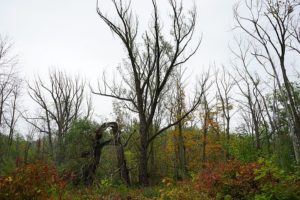
A forest with leafless trees under a cloudy sky, surrounded by sparse green and autumn-colored foliage, evokes the careful work of tree removal in Montclair NJ that helps maintain natural beauty and safety in changing seasons.
If the trees are still in good health and structurally sound, they can be treated. If you decide to move forward with the treatments, please realize that depending on the insecticide, they will need to be treated every one to two years until EAB leaves the area; which is typically around 8 years.
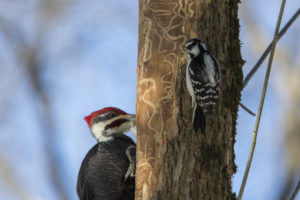
A large pileated woodpecker and a smaller downy woodpecker cling to a tree trunk marked with tunnels, standing out against the blue sky—nature’s contrast before expert tree removal in Montclair NJ helps manage urban forests.
There are various treatment options, but our go to method is using direct injection into the tree. A small hole is drilled into the tree through the bark into the cambium layer and then a pressurized capsule is placed into this hole in the tree and the insecticide is taken up and spread throughout the tree. This limits insecticides being placed in the ground or on the trunk. We feel it is the most environmentally friendly approach.
I feel healthy trees are worth treating and maintaining as the replacement and aesthetic value of the Ash Trees to New Jersey is a great natural resource. Call Arbor Ace Tree Service LLC to come out and assess the health of your Ash Trees and discuss treatment options before it is too late. Once certain thresholds are met, the only option becomes removal. If the trees are recommended for removal, they should be removed right away, as Ash trees rot apart very quickly and the longer they are left up, the more hazardous and costly the removal becomes
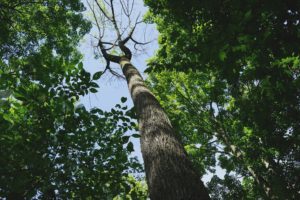
View from the ground looking up at a tall tree with a thick trunk and sparse branches near the top, surrounded by lush green foliage and a bright sky—perfect inspiration for expert tree removal in Wayne NJ.
A dying ash tree infected by Emerald Ash Borer. Photo by Michael Hunter/Wikimedia Commons

What are the signs?

  • Yellow or wilted foliage, or decreased density of healthy-looking leaves
  • Heavily infested trees will display canopy die-back, which is when the top of the tree thins out
  • Many small holes, like ones a woodpecker may impress upon wood
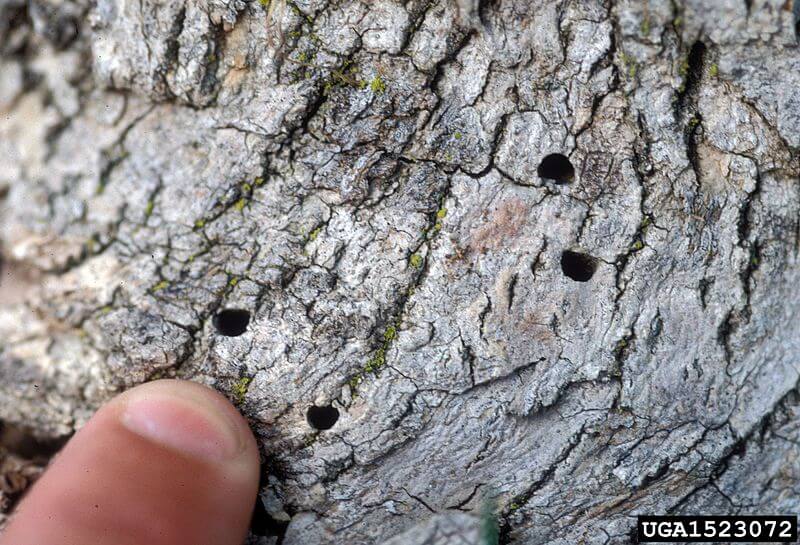
  • Exit holes in the shape of a capital D, creating an emergence hole that is about 1/8 inch in diameter
  • Splitting or cracking of bark
A close-up of tree bark with four small, round holes clustered together. A person's finger points toward the holes, highlighting their size and placement—an important detail for anyone considering tree service in Wayne NJ.

D-shaped exit holes from emerald ash borer adults. Attribution – By Daniel Herms via Wikimedia Commons

Interesting Facts About the EAB

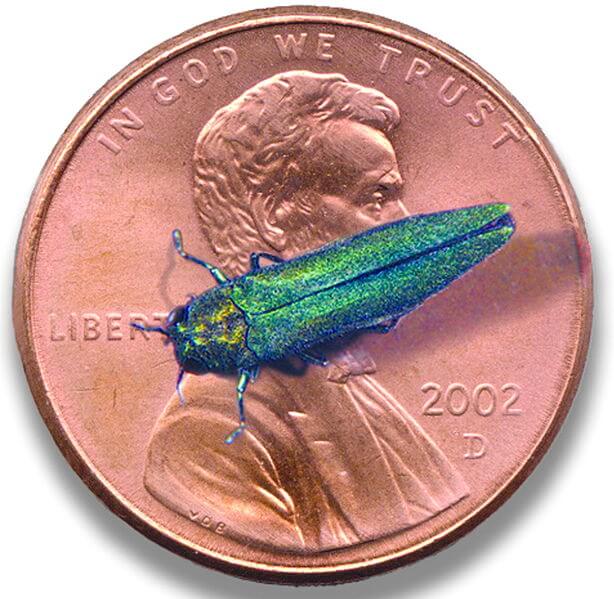
A shiny green and blue beetle is sitting on a 2002 U.S. penny, partially covering Abraham Lincoln's face—an unexpected sight while waiting for a tree service in Montclair NJ.

Size of an Emerald Ash Borer as displayed on a US Penny Attribution – By Howard Russell via Wikimedia Commons

  • The EAB threatens the source of ash trees
  • The most extensive damage is done during the larva stage(larval), because the EAB larva feeds on tissue in the tree that delivers water and nutrients to the tree
  • Adult EABs begin emerging in Mid-Spring with peak emergence in early to Mid-June
  • About two weeks after emerging, adult female EABs begin to hatch eggs
  • Larva feed for several weeks before entering the Pupal Stage. Once the Pupal Stage is complete, adults begin a new life cycle
  • Adult EABs only live for about three weeks

    Call or Text

    (973) 903-1641

    For Your Free Tree Inspection & Estimate!


    Round yellow and black logo for the National Commission Certification of Crane Operators (CCO), featuring a crane hook and “CCO” in the center—a mark trusted by tree service in Montclair NJ for safe, certified crane operations.

    Certification of Crane Operators #1904173859